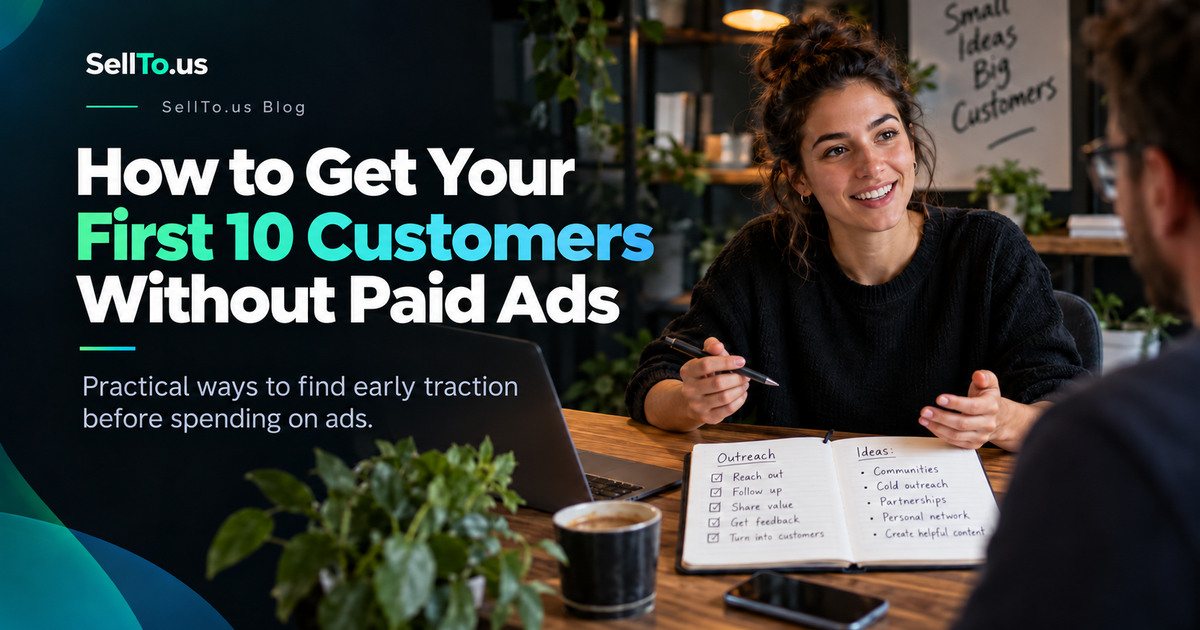
How to Get Your First 10 Customers Without Paid Ads
A practical, low-budget plan to find your first 10 customers through personal outreach, small communities, useful demos, and real conversations.
On this page
- Start with a problem, not a platform
- Make a list of 30 people, not 30,000 followers
- Ask for a conversation, not a credit card
- Show the smallest useful version
- Make one clear offer
- Track actions, not encouragement
- A realistic seven-day starting plan
- Don’t confuse early sales with a repeatable business
- The bottom line
A founder can spend three weeks choosing a font and another two arguing with themselves about a logo. Then launch day comes, the website goes live, and almost nobody visits.
It’s a miserable feeling. It’s also a pretty normal one.
The good news is that getting your first ten customers doesn’t always require a large audience or an ad account. At the beginning, it’s often more useful to find a small number of people with a specific problem and talk to them directly. The work is unglamorous, but you learn things advertising dashboards can’t tell you.
Let’s make the goal concrete: ten real customers, not ten compliments, ten Instagram likes, or ten friends promising to buy someday.
Start with a problem, not a platform
Imagine you’ve built an appointment-reminder tool for independent barbers. You could market it as a general productivity app. Or you could start with barbers who lose time chasing clients who don’t show up.
The second approach gives you a clearer person to find and a simpler conversation to begin.
Write down three things:
- Who: A specific person or type of business.
- When: The frustrating situation that makes your offer relevant.
- What changes: The result they’ll notice if your idea works.
For example: “I help independent barbers spend less time confirming appointments.” That’s a more useful opening than “I built an innovative scheduling solution.”
If you can’t describe the problem in one sentence, use the free Startup Assumption Checker to expose what you may still be guessing about.
Make a list of 30 people, not 30,000 followers
Your first customers are unlikely to arrive evenly from everywhere. Start where you can actually find the people you’ve described.
For a local service, that might mean businesses within a few miles. For a developer tool, it might be a small community of people using a specific framework. For a consulting offer, it could be business owners in an industry you understand.
Build a simple list with a name, reason they’re relevant, contact channel, and follow-up status. Don’t scrape thousands of strangers or send an identical pitch to everyone. A list you can research and act on thoughtfully is better than a giant list you don’t understand.
Try to find around 30 plausible people or businesses to approach. It’s a starting workload, not a conversion formula.
Ask for a conversation, not a credit card
The first message should sound like a person wrote it. Here’s an example for the barber tool:
Hi Jordan, I’m talking to independent barbers about missed appointments. I’m exploring a simple reminder tool and wondered how you currently handle confirmations. Would you be open to two quick questions? No sales pitch.
If they reply, ask how they solve the problem now, what frustrates them, and whether they’ve tried to change it. Listen before explaining your solution.
Don’t claim to have researched their business if you haven’t. Don’t pretend to be a customer. And don’t follow up repeatedly when someone isn’t interested.
Show the smallest useful version
A long pitch deck is rarely necessary. Depending on your business, you might show a sketch, a short demo, a landing page, or a sample result.
The point isn’t to impress someone with everything you plan to build. It’s to help them decide whether your offer would make their day meaningfully easier.
For a service, offer a clearly scoped pilot. For a software product, show the key workflow. For a physical product, show an accurate prototype or explanation and be honest about what’s not ready.
Pay close attention to the next question people ask. “Can I try it?” is different from “That sounds cool.”
Make one clear offer
Early founders often make people work too hard to buy. They leave prices vague, describe too many packages, or ask customers to schedule a call without explaining why.
Try an offer a customer can understand in a few seconds:
- Who it’s for.
- What they get.
- What it costs or how the pilot works.
- What happens next.
You can change the price later. You just need a real proposition to put in front of someone now.
If you’re still unsure about objections, SellTo.us’s free Objection Finder can help you brainstorm questions to verify in real conversations. It doesn’t replace those conversations.
Track actions, not encouragement
Here’s a simple early-customer tracker:
| Stage | What to record |
|---|---|
| Contacted | How many relevant people you approached |
| Replied | Who answered and what problem they described |
| Tried | Who took a meaningful first step |
| Paid | Who actually purchased or booked |
| Returned | Who came back or referred someone |
You don’t need a complicated CRM. A spreadsheet is fine.
What matters is seeing where people stop. If nobody replies, your audience or opening message may be wrong. If people agree to see a demo but never try it, the offer may not feel urgent. If people try once and leave, the problem might be onboarding or product value rather than marketing.
A realistic seven-day starting plan
Day 1: Pick one narrow customer group and write down their problem.
Day 2: Research 20–30 relevant people or businesses. Note why each is a fit.
Days 3–4: Send a handful of thoughtful messages and arrange short conversations.
Day 5: Show a small demo or concrete offer to the interested people.
Day 6: Follow up where invited, answer objections, and improve the offer.
Day 7: Review the responses and decide what to test next.
You may not get ten customers in a week. That’s not the point of the exercise. The point is to start the learning process before spending money to amplify a message that hasn’t connected yet.
Don’t confuse early sales with a repeatable business
Finding ten customers through personal effort is valuable, but it doesn’t prove your marketing will scale. Some may know you, have unusual needs, or receive more attention than you can offer everyone.
Once you have early buyers, ask which parts of the journey repeated and which depended entirely on your own involvement. That’s where your next growth experiment begins.
The early-stage essay “Do Things That Don’t Scale” makes a related point: founders often need to recruit and serve their earliest users manually before a repeatable growth process emerges.
Frequently asked questions
Can I get my first customers without a website?
For some services and early-stage offers, yes. You still need a trustworthy way to explain what you’re offering and complete the transaction. Apps and online products may require at least a basic working experience.
Should my first ten customers get a discount?
Only if there’s a clear reason, such as a limited pilot with defined scope. Don’t use a discount to avoid learning whether people value the offer.
When should I start paid advertising?
Consider it once you know who you’re trying to reach, what action you want them to take, and how you’ll tell whether the campaign is worthwhile.
The bottom line
Ten customers won’t appear because you polished your homepage one more time. They become possible when you understand a specific person, make a useful offer, and invite them to act.
If you’re still refining what to offer, explore your concept with SellTo.us to identify possible objections and real-world questions worth testing. AI-simulated feedback is a starting hypothesis, not proof of customer demand.
Written by the SellTo.us Team. Examples in this article are hypothetical. SellTo.us results come from AI-simulated participants, not real people, and don’t predict sales or guarantee success.
Related articles
From Startup Idea to First Customers: A Practical Validation Roadmap
The path from idea to first customers is a sequence of small decisions. This roadmap lays out each one in order, with links to go deeper wherever you need to.
How to Find People for Customer Interviews in 2027
Good questions are useless without the right people to ask. Where to find them, what to send so it doesn't read like a pitch, and how to keep real conversations on the calendar.
Startup Launch Checklist: What to Do Before Launching
Launching is less about one big day and more about a sequence of small, checkable steps. Use this checklist to see what is done, what is missing and what to verify.