SellTo.us vs ChatGPT: Why Use a Dedicated AI Idea Testing Platform?
Published October 15, 2026 · SellTo.us Team · 9 min read
ChatGPT, Claude, Gemini and Copilot are excellent general assistants. So why use a dedicated platform when you could simply ask a chatbot what people will think of your idea? Here is the honest difference, what each tool is good at, and when to use which.
The short answer
An AI chat gives you one well-written opinion. SellTo.us builds a crowd of up to 100,000 AI-simulated people for your audience, asks each of them about every version of your idea, and counts their answers with code. You get numbers you can compare by audience group, re-test after a change and download as a PDF. It is still AI imagining reactions, not real customers: a fast first check, not proof.
Two different jobs: a conversation and a test
A general AI assistant is built for conversation: perfect when you want to think, write or learn. But “what will my audience think of this?” is a measurement question: how many people in which groups react well to which option, and why the others hold back.
That needs things a chat doesn’t give you by default: a fixed set of respondents, the same question for every option, answers stored one by one, counts you can check, and a way to repeat the test after a change. A dedicated idea testing platform provides that structure. The AI underneath can be just as capable; the difference is what is built around it.
What ChatGPT and other AI chats do best
Let’s be fair first. A general AI chat is one of the best thinking partners you can get. It is great for:
- Brainstorming: names, angles, features, twenty versions of a headline.
- Thinking out loud: “What could go wrong with this?”, “Who might buy this?”
- Writing: landing pages, emails, ad copy and interview questions.
- Explaining: pricing models, marketing terms, how a market usually works.
If you need ideas, use a chat. The trouble starts when you ask it to judge your idea the way a whole audience would.
How a structured SellTo.us test works
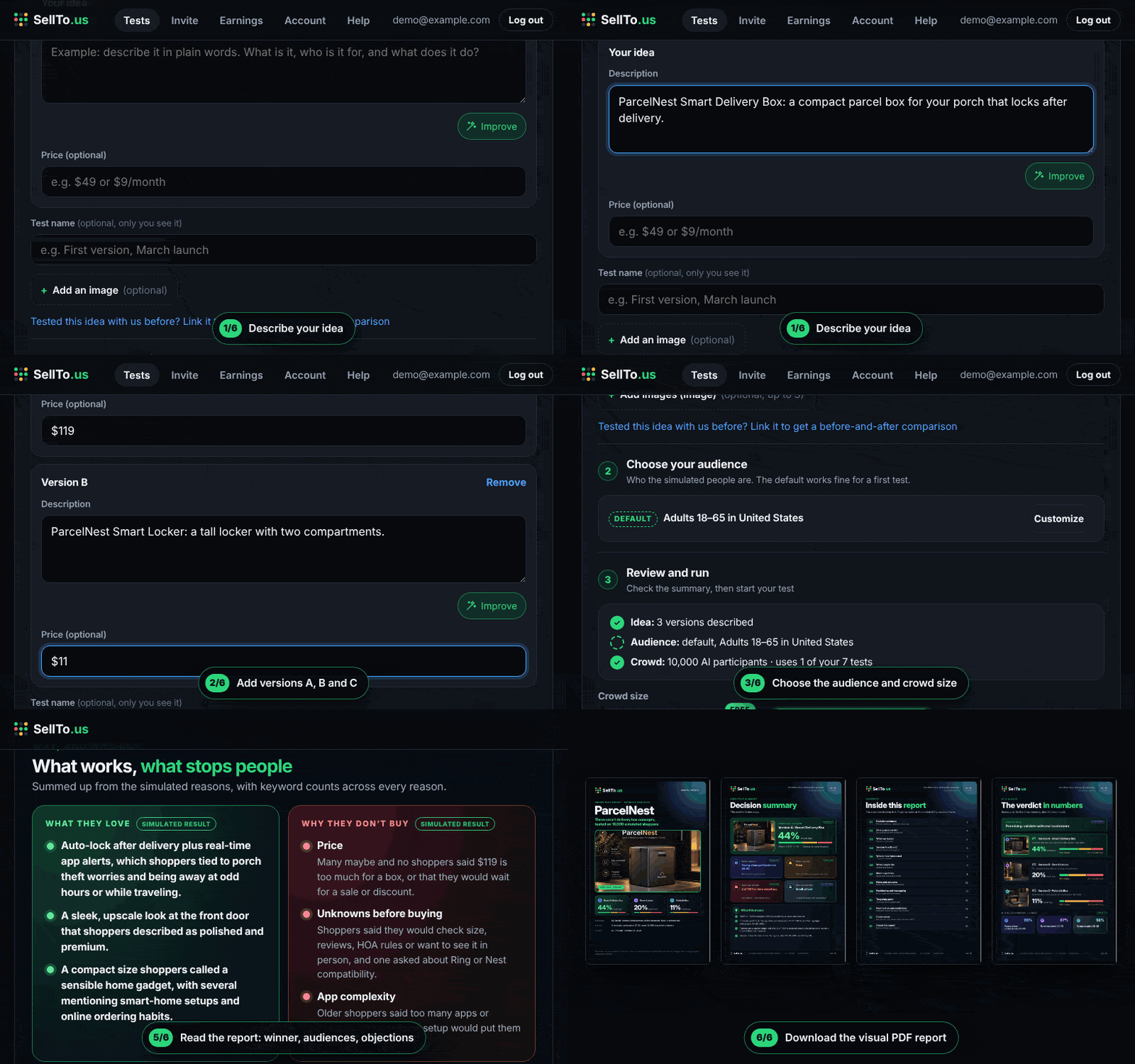
Ask a chatbot “Would people buy this?” and you get one answer, written in one go. Word it differently and you may get a different verdict, with nothing to tell you which to trust. A SellTo.us test is built step by step:
- The crowd is planned for your audience. An AI model splits your audience into 8, 25 or 100 groups, each with its share, an age range, typical jobs, a budget level and how they shop.
- Our code creates every person. A 10,000-participant test has exactly 10,000 profiles, rebuilt for a re-test at the same size.
- Every person answers every version. Each simulated person gives a verdict (for example would buy, maybe or wouldn’t buy) and a short reason, for each version.
- The numbers are counted, not written. Percentages are answers divided by the people who answered. Broken answers are skipped, never guessed.
- The write-up is checked. The AI explains the counts; code checks it sentence by sentence.
So instead of “I think people would like it”, you get “44% of 10,000 simulated shoppers would buy Version A, 20% Version B, and the renters in your audience barely respond”. Still a simulation, but one you can measure, compare and repeat. Every step is documented on How it works.
SellTo.us vs ChatGPT and other AI chats, side by side
| What you need | ChatGPT, Claude, Gemini & other chats | SellTo.us |
|---|---|---|
| Who answers | One assistant, in one reply | 1,000, 10,000 or 100,000 AI-simulated people, each with an age, job and budget level |
| Where the % comes from | Written by the model as part of its answer | Counted by code from every individual answer |
| Audience insights | Described in words if you ask | 8, 25 or 100 audience groups, each with its own result, plus the groups that barely respond |
| A/B/C comparisons | One opinion about all options at once | Every person judges every version: up to 3 (10,000 test) or 5 (100,000 test) |
| Pricing tests | General advice on pricing | Test the same idea at different prices as versions; reactions by budget level; a price to test next |
| Objections | A list of possible objections | The reasons simulated people gave for “no”, summed up and counted by topic |
| Re-testing | A new chat, with nothing to compare against | Before vs after on the very same simulated people (same test size) |
| Checks on the write-up | You check it yourself | Code removes numbers that don’t match, new product claims and unsourced figures |
| What you get | A chat transcript | A results screen and a visual PDF report you can share |
| Speed and cost | Seconds; often free or a monthly subscription | 10 to 28 minutes; first 1,000-person test free if eligible, then from $19 |
| Best for | Ideas, writing, explaining, brainstorming | A structured first check of how an audience might react |
✓ built in · ~ in words or with extra effort · – not in an ordinary chat. Assistants change often; this compares an ordinary chat conversation, not every tool or plan.
What you get in a SellTo.us test
All of this is in the product today; bigger tests add groups, versions and interviews (see pricing).
Simulated audiences
Describe your customers or keep the default. AI plans the audience groups; our code creates every simulated person, with an age, job and budget level.
A/B/C concept comparisons
Compare up to 3 versions (10,000 test) or 5 (100,000 test): headlines, offers, ads, photos or concepts. The free 1,000 test checks one.
Audience insights
See which groups lean in, which ignore you, and a warning when part of your audience barely responds, before you spend ad money.
Pricing tests
Run the same idea at $29, $49 and $79 as three versions. The report also shows reactions by budget level and a price to test next.
Objections
Every “maybe” and “no” comes with a reason. The report sums them up, counts the topics (price, trust, setup…) and suggests fixes.
Re-testing
Change your idea and press Re-test: the same simulated people compare your old and new version, so you see if the change helped.
Visual PDF reports
A designed PDF with a decision summary, charts, audience groups, objections and next steps, every figure labeled as simulated or an AI idea.
Try it on your own idea. 1,000 simulated people, about 10 to 12 minutes, free if eligible.
Test Your Idea for Free“Can’t I just tell ChatGPT to pretend to be 100 customers?”
You can, and it’s a useful warm-up. But in an ordinary chat the same reply invents the people and writes the totals, so a “survey of 100 customers” often comes out suspiciously neat, and 10,000 people in one reply isn’t practical.
To be fair, some assistants can run code, and a technical person could build their own simulation: generate profiles, call a model per person, count the answers, check the summary. That’s a real project. SellTo.us is that project, done for you:
Chat “survey”
- People and totals written in one reply
- Hard to repeat or rebuild
- No record of who said what
- Practical for dozens, not thousands
SellTo.us test
- Code creates the people, AI answers for them, code counts
- Same crowd rebuilt for a re-test
- Every count traced to individual answers
- Up to 100,000 simulated people
What about Claude, Gemini, Copilot and other AI models?
The same answer applies to every general assistant. The difference isn’t which model is smarter; it’s the structure around it. SellTo.us itself runs on Anthropic’s models: Claude Haiku 4.5 answers for the simulated people, and Claude Sonnet 5.5 plans the crowd and writes the report. The platform adds what a chat window doesn’t have: a crowd built by code, one answer per person per version, counting, re-tests on the same people, report checks, and labels saying whether a figure is a Simulated result, an AI hypothesis, Your input or a Verified source.
When to use ChatGPT, SellTo.us or real customers
| Your question | Best tool |
|---|---|
| “Give me 20 ideas for a name or a headline.” | An AI chat, or our free Headline A/B Tester |
| “Roast my idea and tell me the weak spots.” | An AI chat, or our free Idea Roast |
| “Which of my 3 headlines, prices or photos gets the best reaction, and from whom?” | A SellTo.us test |
| “Which audience should I target first, and which one ignores me?” | A SellTo.us test |
| “Did my change actually make it better?” | A SellTo.us re-test |
| “Will people really pay?” | Real customers: a pre-sale, a small ad test or interviews |
A good flow uses all three: brainstorm with a chat, narrow your options with SellTo.us, then put the winner in front of real people. Read more: AI-simulated audiences vs real customer research, how to test startup pricing and how to find customer objections.
It works for startup ideas, apps, services, physical products, ads and AI focus groups.
Honest limits
A dedicated platform is better structured than a chat, but it isn’t magic:
- Participants are AI personas, not real people, and results are simulated reactions, not sales, sign-ups or a forecast. They haven’t been validated against real sales.
- We don’t claim SellTo.us is more accurate than ChatGPT or any other assistant. It is more structured, which makes results easier to compare and repeat, not guaranteed to be right.
- Results depend on how you describe your idea and audience.
- Running the same test again gives somewhat different numbers, so treat small gaps as a tie.
The full list is on How it works. Use SellTo.us to decide what’s worth testing with real customers, not instead of them.
Questions
Is SellTo.us just ChatGPT with a nicer screen?
No. SellTo.us doesn’t use ChatGPT; it runs on Claude models by Anthropic. More importantly, it isn’t a chat: our code creates a fixed crowd of simulated people, every one answers every version, and the results are counted and checked by code. A chat gives you one written opinion.
Is SellTo.us more accurate than ChatGPT, Claude or Gemini?
We don’t claim an accuracy number for any of them: none has been measured against real sales for your idea. SellTo.us gives you structure, which makes results easier to compare and repeat, not guaranteed to be right.
Can I compare versions A, B and C in the free test?
The free 1,000-participant test checks one version. To compare versions side by side, use a 10,000-participant test (up to 3 versions) or a 100,000-participant test (up to 5).
How much does it cost compared with a chatbot subscription?
Your first 1,000-participant test is free if eligible (one per person, no card needed). After that, single tests cost $19, $69 or $279 depending on size, and monthly plans are available. You see the price before you pay.
See the difference on your own idea
Test it on 1,000 AI-simulated people: audience groups, objections and next steps in about 10 to 12 minutes. Free if eligible.
Test Your Idea for FreeSee a sample reportChatGPT is a trademark of OpenAI, Claude of Anthropic, Gemini of Google and Copilot of Microsoft. SellTo.us is an independent service that uses Anthropic’s Claude models through Anthropic’s API; it isn’t affiliated with or endorsed by OpenAI, Anthropic, Google or Microsoft.