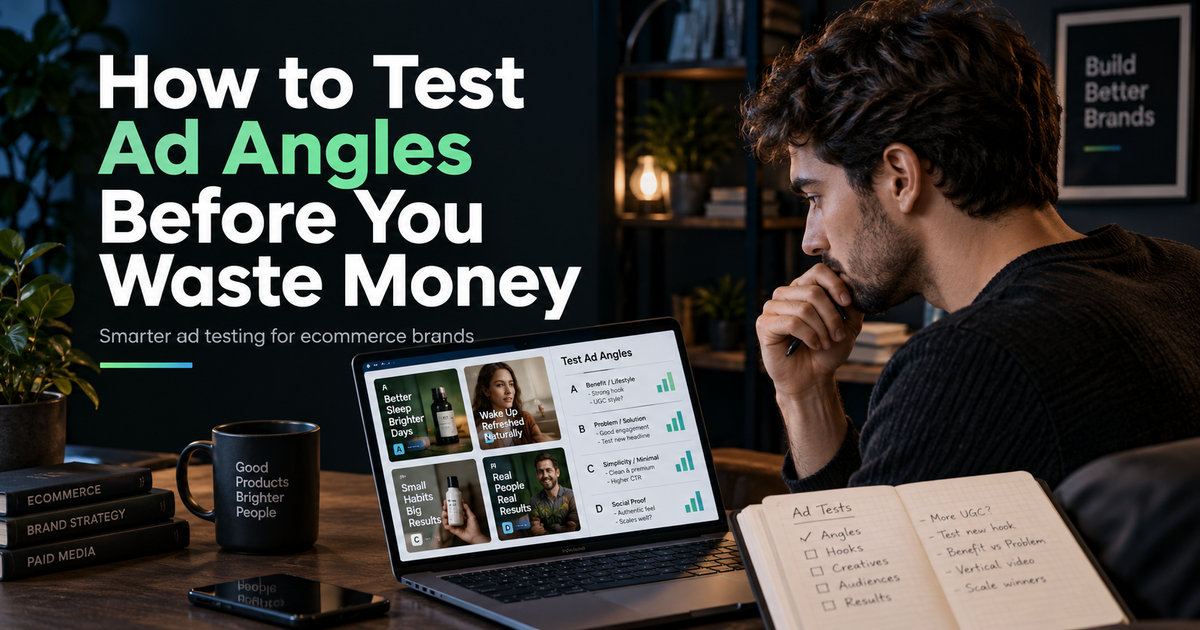
How to Test Ad Angles Before You Waste Money
Learn how to compare ecommerce ad angles, avoid misleading conclusions, and run a small structured test before increasing your ad budget.
On this page
- An ad angle is a reason to care
- Step 1: Write the customer’s situation before the ad
- Step 2: Choose three genuinely different angles
- Step 3: Check comprehension before paying for impressions
- Step 4: Build the test so the result means something
- Step 5: Pick a metric tied to your actual goal
- Step 6: Don’t overreact to tiny samples
- Step 7: Take the learning into the next creative
- A simple starter test plan
- Frequently asked questions
- The takeaway
You’ve got a product you believe in, a few photos, and a small advertising budget. You open your ad account and face a familiar question: What should the ad actually say?
The easy answer is to write something catchy, add a discount, and hope. The better answer is to decide what reason someone might have to care about the product—and test that reason before you spend heavily.
That’s an ad angle. It’s not the font, music, or first three words of the caption. It’s the central way you frame the value of what you’re selling.
A single product can have several plausible angles. But not all of them will matter to the same people.
An ad angle is a reason to care
Imagine you’re selling an insulated water bottle.
You could lead with:
- Practical convenience: Keeps your drink accessible throughout a long workday.
- Routine: Easy to take to the gym, commute, or hiking trail.
- Design: A simple, understated bottle that fits a particular style.
- Durability: A construction feature you can genuinely demonstrate.
These aren’t four different products. They’re four different conversations with a potential buyer.
An angle should connect a real feature to a real use case. Don’t promise performance that you haven’t verified, and be careful with broad environmental, health, or safety claims.
Step 1: Write the customer’s situation before the ad
Start with a person, not a slogan.
Who are they? Where do they encounter the problem? What are they doing now? What would make them consider changing?
For example, “busy professionals” is too vague to produce a useful ad. “People who commute by train and need a compact lunch container that won’t leak in a bag” gives you something tangible.
Now write one sentence about the situation:
“When [specific moment] happens, this person wants [outcome] but struggles with [friction].”
You can build a practical angle from there. This process also protects you from writing clever ads that sound exciting but aren’t connected to the product.
Step 2: Choose three genuinely different angles
Don’t create three ads that differ only by “Shop now” versus “Buy today.” Those are wording changes, not meaningful hypotheses.
For the lunch-container example, your three angles could be:
Angle A — Avoid the mess: Show the lid and demonstrate how it closes securely, assuming the claim is verified.
Angle B — Save space: Show it fitting inside an everyday backpack beside other items.
Angle C — Simplify mornings: Show someone packing lunch quickly before leaving home.
Each angle makes a different promise. That gives you useful information if one resonates more strongly than another.
Keep the brand, offer, landing page, and price as consistent as possible during an initial comparison. Otherwise you may be testing several changes at once without knowing which made the difference.
Step 3: Check comprehension before paying for impressions
A simple, low-cost test is to show each draft to a few people who resemble your intended audience.
Ask:
- What product do you think this ad is selling?
- What is the main reason to consider it?
- What, if anything, feels exaggerated or unclear?
- What would you want to know before buying?
- What makes this different from what you already use?
Don’t ask, “Which one do you love?” People can be polite. You want to know whether they understand the offer and whether it connects to a genuine concern.
For an early comparison, the free SellTo.us Headline Tester can help identify possible clarity and positioning differences. That feedback is AI-generated analysis, not evidence of real click-through or purchase performance.
Step 4: Build the test so the result means something
A common mistake is running Angle A on Monday, Angle B on Thursday, and Angle C after changing the audience. If performance differs, you won’t know why.
A more interpretable setup keeps major factors as similar as practical:
- The same core product and landing page
- The same geographic and audience rules
- The same offer and price
- Comparable placement and format where possible
- Similar test periods
- A pre-decided budget and measurement window
Ad delivery systems optimize automatically, so perfectly controlled experiments can be difficult. If your platform offers a proper experiment or A/B testing feature, use it when appropriate. Don’t treat a quick difference in results as proof that one creative will always win.
The point is to learn which message deserves further testing—not declare a universal winner after a few impressions.
Step 5: Pick a metric tied to your actual goal
If the goal is awareness, you may care about reach or video engagement. If the goal is sales, purchases and contribution margin matter much more.
For an ecommerce store, examine the full path:
| Stage | Useful question |
|---|---|
| Impression | Did the ad reach the intended audience? |
| Click | Was the message interesting enough to visit? |
| Product view | Did the page match what the ad promised? |
| Add to cart | Did the offer feel worth considering? |
| Purchase | Did the visitor complete an economically viable order? |
A headline that produces cheap clicks but attracts uninterested visitors can be worse than a more expensive message that brings buyers who understand the product.
Also account for attribution limits and tracking errors. The ad platform’s reporting is useful, but it isn’t the complete story.
Step 6: Don’t overreact to tiny samples
Suppose Angle A receives three purchases and Angle B receives five. It’s tempting to declare B the winner.
But without understanding traffic volume, random variation, order values, costs, and whether the audiences were comparable, the difference may not mean much.
Before increasing spend, ask:
- Did the ads have enough exposure to support a meaningful comparison?
- Did they reach similar people?
- Is the performance difference sustained or just an early fluctuation?
- Do return rates, support costs, or order values change the picture?
- Does the landing page clearly deliver what the winning ad promises?
You don’t need a statistics degree to be cautious about reading too much into a handful of purchases.
Step 7: Take the learning into the next creative
A good test gives you a clearer understanding of your audience even when the campaign loses money.
If the “save space” angle attracts visits but people ask about capacity, your next creative might show exactly what fits inside. If the convenience angle gets attention but the checkout drops off, look at delivery cost and trust rather than writing ten more headlines.
Write down what you learned after each test:
Hypothesis → What was tested → What happened → What we don’t know yet → Next action.
That last part matters. Without a record, you can end up repeating the same experiment every time you launch a new product.
A simple starter test plan
For your first round, keep it manageable:
Day 1: Interview a few potential customers about the problem and current alternatives.
Day 2: Draft three angles with one primary promise each.
Day 3: Check clarity and factual claims. Remove anything you can’t substantiate.
Day 4: Prepare comparable creatives and a consistent product page.
Days 5–7: Run a limited, pre-budgeted experiment if the economics justify it; otherwise gather more direct feedback first.
Afterward: Review the entire purchase path and choose one next hypothesis.
The exact schedule depends on your budget, traffic, and platform. There’s no magic seven-day guarantee.
Frequently asked questions
What’s the difference between an ad angle and an ad hook?
The angle is the underlying value proposition or customer situation. The hook is the opening line, image, or moment that gets attention. Several hooks can communicate one angle.
How many ad angles should a beginner test?
A small set of distinct hypotheses—often two or three—is easier to interpret than dozens of nearly identical creatives. Keep the number appropriate to your budget and ability to measure results.
Can AI predict the best ad angle?
AI can help assess message clarity and generate hypotheses about objections. It cannot reliably guarantee which message real people will click or buy from. Use live testing for performance decisions.
The takeaway
You don’t have to spend a fortune to learn what matters to customers. You do need a clear hypothesis, an honest claim, a consistent test, and the discipline not to confuse early clicks with a profitable business.
Use SellTo.us to explore possible simulated audience objections before launching a campaign, then use actual customer behavior to decide what deserves more money.
Written by the SellTo.us Team. Examples in this article are hypothetical. SellTo.us results come from AI-simulated participants, not real people, and don’t predict sales or guarantee success.
Related articles
How to Test Ad Creative on a Small Budget in 2027
Small budgets can't find tiny winners, but they can catch big differences. How to set up creative tests that give a usable answer before the money runs out.
How to Compare Marketing Headlines Before Running Ads
Two headlines, one budget. Learn how to judge which one says more to the right people, why opinions can't predict clicks, and how to run a fair real-world split test.
How to Validate Marketing Messages Before Spending on Ads
Before you pay to show a message to thousands of strangers, make sure it is clear, aimed at the right people and built around a strong offer. Here is a step-by-step process.