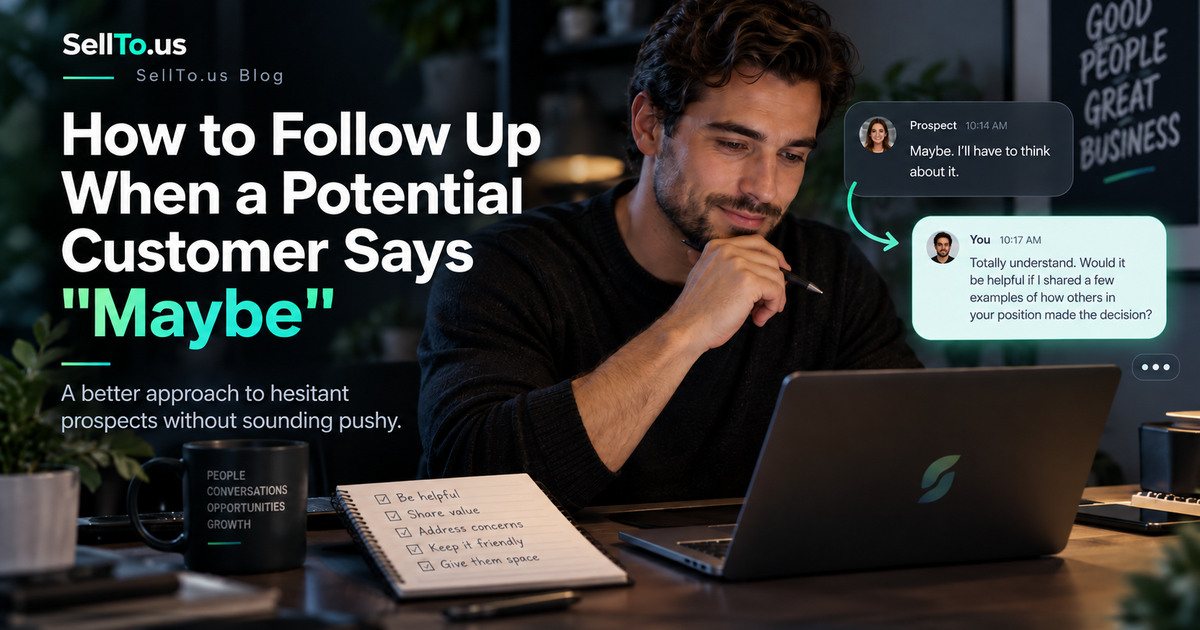
How to Follow Up When a Potential Customer Says "Maybe"
Learn how to follow up after a sales prospect says maybe, uncover the real hesitation, send useful messages, and avoid pushy outreach.
On this page
- First, figure out what kind of maybe you heard
- Ask one question before the conversation ends
- Send something that answers the hesitation
- Don’t use fake urgency
- What if they don’t reply?
- Use the response to improve your business idea
- Keep a lightweight follow-up record
- When a maybe should become a no
- Use rejections to refine the next pitch
- The bottom line
You explain your new service. The other person listens, asks a couple of questions, and says, “Sounds interesting. Let me think about it.”
You walk away feeling hopeful. A week later, you haven’t heard anything.
Was that a polite no? Did they forget? Is the timing wrong? Did you fail to explain the value?
The honest answer is that you don’t know yet. And that’s why the best follow-up isn’t a more aggressive sales pitch. It’s a useful way to understand what the person still needs to decide.
First, figure out what kind of maybe you heard
Not all hesitation means the same thing.
A potential customer might be thinking:
- “I understand it, but this isn’t urgent right now.”
- “I like it, but I don’t have the budget.”
- “I’m not sure I trust a new provider.”
- “I need approval from someone else.”
- “I didn’t understand the offer well enough to say yes.”
- “I’m just being polite and don’t want to continue.”
If you assume every maybe is about price, you’ll offer unnecessary discounts. If you assume it’s a timing problem, you’ll keep sending reminders to people who aren’t interested.
A brief, respectful question is more useful than guessing.
Ask one question before the conversation ends
Instead of “Okay, I’ll follow up next week,” try:
Of course. What would be the most useful thing for you to see or know before deciding?
You might learn that they need a simple example, a cancellation policy, a conversation with a partner, or a clearer explanation of what happens after purchase.
You could also ask, “Would it be helpful if I checked back next week?” Then respect the answer.
This small step changes the follow-up from an interruption into something they agreed might be useful.
Send something that answers the hesitation
A useful follow-up has three parts:
- A reminder of the specific conversation.
- The relevant information they asked for.
- One easy next step, with permission to say no.
For a business owner concerned about implementation:
Hi Casey, thanks for taking a look at the scheduling idea on Tuesday. You mentioned that moving existing appointments sounded like a headache. Here’s a short walkthrough showing what setup would involve. If it’s still relevant, happy to answer questions. If not, no worries at all.
This is different from “Just circling back!!!” because it helps the recipient make an actual decision.
Don’t use fake urgency
If there is a real deadline (a cohort closing, an event date or a genuinely limited-capacity service), you can explain it.
But don’t invent scarcity, claim that prices are increasing when they aren’t, or send “last chance” messages every three days.
Trust is hard to earn and easy to lose. People remember when they feel manipulated.
What if they don’t reply?
One unanswered follow-up isn’t a request for a month of additional messages.
If the person invited a check-in, follow up at the agreed time. If they didn’t, you can consider one concise, relevant follow-up where lawful and appropriate. After that, give them space.
A final note can be simple:
I haven’t heard back, so I’ll close the loop here. If this becomes relevant later, you’re welcome to reach out. Thanks again for considering it.
If someone opts out, tells you to stop, or has an unsubscribe preference, honor it. Email outreach also needs to follow applicable laws and platform rules.
Use the response to improve your business idea
Even when someone doesn’t buy, the conversation can tell you something useful.
Imagine you’re offering a $40-per-month client portal to small design agencies. Three prospects say they already manage approvals in email. One says the portal is attractive but won’t make clients switch tools. Another doesn’t understand who needs to log in.
That might suggest the real problem isn’t the monthly price. It’s the work required to change behavior.
An effective next experiment could be a product demo that begins with an email link and requires no account from the client’s side. But that suggestion is only a hypothesis until you try it with real prospects.
You can use the free Objection Finder to brainstorm other plausible barriers, then confirm the important ones in real discussions.
Keep a lightweight follow-up record
A complex sales system isn’t necessary for a handful of early conversations.
A simple tracker might have:
| Field | Example |
|---|---|
| Person | Casey, independent design agency |
| Problem | Client approvals take too long |
| Concern | Clients won’t adopt another login |
| Requested | Simple onboarding walkthrough |
| Follow-up permission | Yes, next Tuesday |
| Outcome | Waiting for response |
This keeps follow-up relevant and helps you notice repeated objections instead of relying on memory.
When a maybe should become a no
Sometimes the right result is realizing you aren’t a fit.
If the person doesn’t experience the problem, doesn’t have authority to buy, can’t use the product safely, or clearly prefers their current solution, continuing to push wastes their time and yours.
A clear no can be more valuable than an indefinite maybe. It frees you to focus on customers whose needs actually match your offer.
Use rejections to refine the next pitch
After several conversations, look for patterns:
- Are people confused about the core value?
- Do they need a different buyer to approve the purchase?
- Are they worried about reliability or support?
- Does the first-use experience feel complicated?
- Is the problem simply not urgent enough?
Each answer points toward a different change: message, workflow, evidence, target customer, or product itself.
Avoid the trap of constantly rewriting your headline when the underlying issue is that people don’t have the problem you solve.
Frequently asked questions
How long should I wait before following up?
Use the timing the person agreed to. If there wasn’t an agreement, don’t assume frequent follow-ups are welcome. Context and applicable outreach rules matter.
Should I offer a discount after a maybe?
Not automatically. First learn what is holding up the decision. A discount won’t solve trust or usability concerns.
What should I do if a prospect says they’re not interested?
Thank them and respect the decision. If they’re willing, ask for one piece of feedback without pressure. Don’t continue promotional outreach against their wishes.
The bottom line
A good follow-up doesn’t force a yes. It makes the next decision easier.
When you treat maybe as a question rather than a challenge, you’ll learn more, protect trust, and find out which parts of your offer need work.
For your next concept iteration, SellTo.us can help explore possible objections using AI-simulated audiences. Use those suggestions to prepare better real conversations, not as substitutes for them.
Written by the SellTo.us Team. Examples in this article are hypothetical. SellTo.us results come from AI-simulated participants, not real people, and don’t predict sales or guarantee success.
Related articles
How to Find Customer Objections Before Launching a Business
Every new offer meets hesitation. Here is how to find the reasons people might say no before launch day, check which ones are real and fix them in your offer and message.
How to Find People for Customer Interviews in 2027
Good questions are useless without the right people to ask. Where to find them, what to send so it doesn't read like a pitch, and how to keep real conversations on the calendar.
How to Test Startup Pricing Without Guessing
Your first price is a hypothesis, not a decision. Learn how to choose a pricing model, gather evidence from real buyers and avoid trusting what people say they would pay.